By Izunna Okafor, Awka
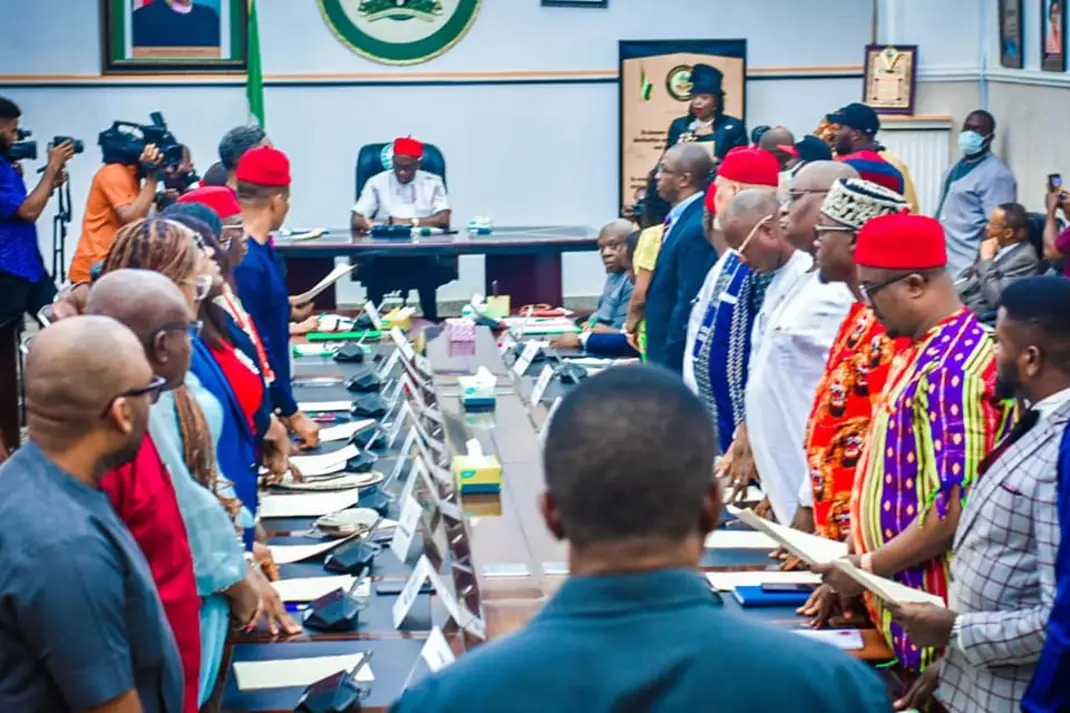
The political atmosphere in Anambra State has become charged with uncertainty following the dissolution of the first-term Executive Council and other political appointments by Governor Chukwuma Charles Soludo, a development that has left the fate of many immediate-past commissioners, special advisers, and other aides unknown as the administration prepares to constitute a fresh team for the new tenure.
The governor had, on Wednesday, shortly after his swearing-in for a second term on Tuesday, directed all political appointees to hand over to Permanent Secretaries or the most senior civil servants in their respective Ministries, Departments and Agencies, effectively bringing the first phase of the administration to a close.
While the dissolution is a routine procedure at the beginning of a new tenure, speculations abound that the situation has generated unusual suspense within political circles, as many appointees who served in the last four years are unsure whether they will be retained, redeployed or completely dropped from government.
This is more so as the outgoing cabinet had a mix of performances, with some commissioners and aides widely commended for exceptional service in their respective offices, while others were often criticised in public discussions for not meeting the expectations of the people or for failing to make visible impact in their assigned roles.
Reports have it that appointments in government usually come through different routes, as some individuals are nominated based on professional competence and track record, some as reward for loyalty and long-standing political support, while others emerge through recommendations by influential stakeholders, party leaders, community interests, or other strategic political considerations.
In the first tenure of Governor Soludo, a number of appointees reportedly came into office through the efforts of support groups and mobilization structures that played active roles during the 2021 governorship election, a factor that contributed to the diverse composition of the cabinet at the time.
However, the political dynamics that produced the first-term appointments appear to have changed considerably ahead of the 2025 governorship election, as the level of open campaign mobilization by support groups was noticeably reduced, a situation some insiders attribute to a deliberate decision and directive by the governor to streamline the political process and go to the poll without such usual activities of support groups. Some others, however, believe it was the result of internal party adjustments.
Notwithstanding what the reason was, this shift has further deepened uncertainty over the future of some appointees who initially emerged through those platforms and support groups, as it is unclear whether the same considerations will apply in the formation of the new cabinet.
At the same time, party faithful and stakeholders who played key roles in the governor’s re-election are also believed to be expecting recognition, which is another consideration that could lead to fresh appointments and possible replacement of some members of the dissolved cabinet.
Unarguably, in political practice, such changes are often inevitable, as new entrants must be accommodated, meaning that some former office holders may have to step aside to create room for others considered to have contributed significantly to the success of the administration or the Governor’s re-emergence for the second term.
There are also indications that some officials who joined the government midway into the first tenure may stand a stronger chance of being retained, especially if their performance is adjudged satisfactory, while a few who had served even before the present administration, including those whose appointments dated back to the era of former governor Willie Obiano, may either be replaced or reassigned, depending on the strategic needs of the new government or decision of the Governor. Nonetheless, it is believed that continuity may still be considered in certain cases, particularly where experience and institutional memory are seen as valuable to ongoing projects, especially as the government is still under the same political platform.
It is also expected that some former appointees may be redeployed to different offices where their skills could be better utilized, while others may return to private business, professional practice or personal ventures from which they were called to public service. A few may also choose to pursue elective positions in the 2027 general elections, using their experience in government as political capital, while others may simply step back from active politics after their time in office.
Also worthy of mention is the fact that within public conversations across Anambra state since the dissolution of the first term cabinet by Governor Soludo, reactions have been mixed, as some outgoing officials are being praised for dedication and accessibility while in office, even as others are being criticised for becoming distant from the people who once supported them.
In many communities and social circles, it is being said that public office often changes relationships, as some appointees who were once easily reachable became difficult to access immediate they assumed power, only for such barriers to disappear once their tenure ended, which is a reality many describe as part of the lessons of political life.
Despite these speculations, many Ndị Anambra have this strong belief that Governor Soludo will ultimately select a team capable of sustaining the pace of development recorded in the first tenure, especially after assuring Ndi Anambra in his inaugural speech that the new administration would operate at a higher level of performance, which he described as changing to “Gear-4.”
With major projects in infrastructure, security, economic reform and public service modernization still ongoing, the composition of the next cabinet is expected to play a decisive role in determining how the second term of the Soludo administration will flow.
Whatever the outcome of the composition, these developments have confirmed the reality that in politics, no position is permanent, just as no condition is permanent in life.
As Governor Soludo moves to assemble the next team to drive the next phase of transformation in Anambra, the fate of several immediate-past commissioners, special advisers and other political office holders remains hanging and uncertain, with expectations, speculations and quiet lobbying believed to be gathering momentum across political camps and interest groups in the state; and may so remain until the Governor finally unveils his next team.
Izunna Okafor writes from Awka, Anambra State.