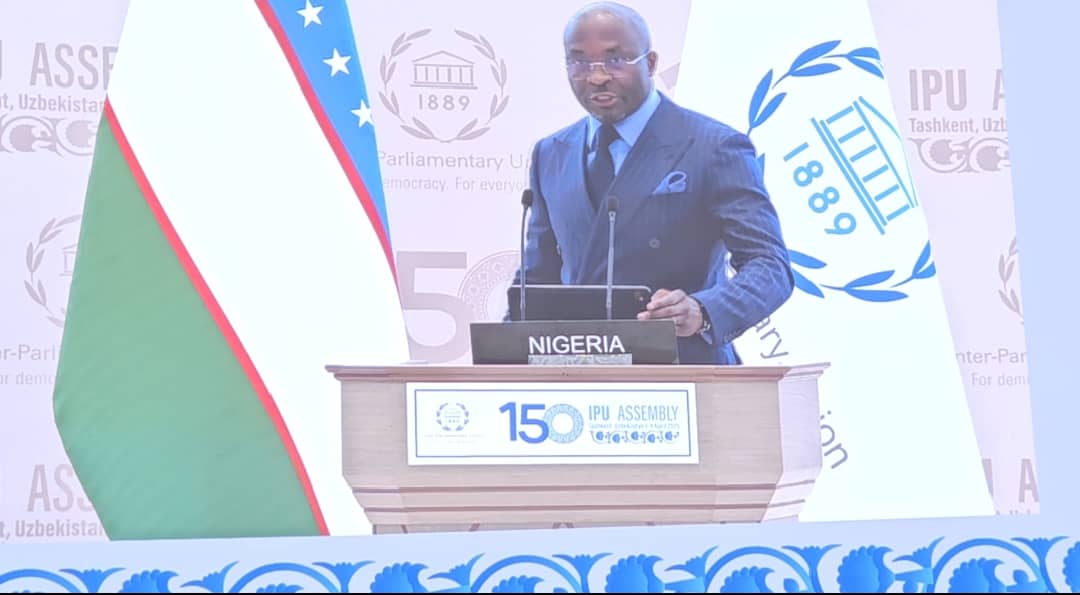
Deputy Speaker of Nigeria’s House of Representatives, Benjamin Kalu has called on countries of the world to priorities the development and implementation of robust frameworks for post-war recovery.
He made the call in a proposal titled “The Imperative for Strengthened Post-War Management” at the ongoing 150th General Assembly of the Inter-Parliamentary Union (IPU) at Tashkent, Uzbekistan.
The deputy speaker, who was named a co-rapporteur to the IPU’s Standing Committee on Peace and International Security to speak on “The role of parliaments in establishing robust post-conflict management mechanisms and restoring a just and lasting peace” alongside A. Al-Zu’bi of Jordan and Ms. F. Belhirch of Netherlands.
He noted the devastating effects of conflicts and wars in Sudan and Democratic Republic of Congo (DRC).
He said “Despite multiple peace agreements, sporadic violence persists due to inadequate post-conflict reconstruction and weak governance structures.
“The failure to establish a resilient peacekeeping and reconstruction
framework has left Sudan vulnerable to renewed conflict. Economic marginalization and weak institutions have further impeded sustainable peace,
demonstrating the need for stronger mechanisms in post-war
management.
“The DRC has been plagued by conflict since the 1990s, including the First and Second Congo Wars, which have been termed “Africa’s World War” due to their scale and the involvement of multiple neighboring countries.
“The wars have resulted in over 5 million deaths, primarily due to disease, starvation, and violence. The region continues to experience sporadic conflict, undermining decades of fragile peace efforts.
“Weak post-war governance, pervasive corruption, and insufficient integration of conflict resolution strategies have prevented lasting stability.
“The international community’s inability to enforce comprehensive peace agreements has contributed to an environment where recurring violence is the norm.
“The historical trajectory from World War I to regional conflicts in Sudan and the DRC reveals a persistent pattern: the failure to establish strong post-war management mechanisms results in recurring cycles of violence and instability.
“To break this cycle, the international community, in collaboration with national governments, must prioritize the development and implementation of robust frameworks for post-war recovery.”
Kalu further stated that the experiences of both Sudan, the DRC and indeed, other war-torn places in the world demonstrated that victory in conflict is only the first step in peace initiatives.
He therefore demanded institutional strengthening, economic reconstruction, social reconciliation, integration as a healing mechanism and international support.
Echezona Okafor.