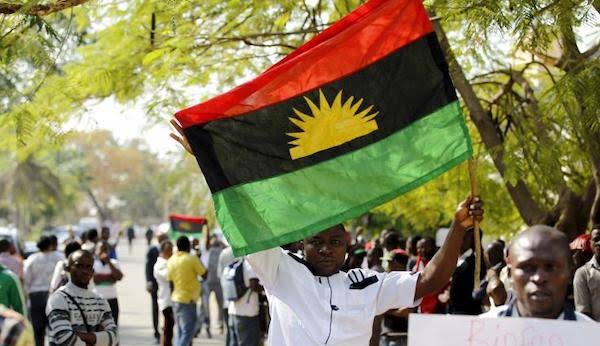
The Indigenous People of Biafra (IPOB) has strongly criticized what it describes as a deliberate and recurring misrepresentation of its activities by Nigerian security agencies.
The group accused the authorities of routinely blaming IPOB and its affiliate, the Eastern Security Network (ESN), for virtually all crimes across the country—regardless of merit.
This position was stated in a press release issued on Tuesday by IPOB’s spokesperson, Emma Powerful, who called the alleged pattern of scapegoating both “hypocritical” and “deceptive.”
He pointed to a recent case in Katsina State where a woman was arrested for impersonating a Nigerian soldier while fully dressed in military attire and carrying loaded magazines. According to Powerful, the incident reveals glaring inconsistencies in how law enforcement handles security breaches involving different ethnic or regional groups.
“The recent arrest of a woman brazenly impersonating a Nigerian soldier in Katsina State—adorned in full military regalia and armed with loaded magazines—has once again unmasked the staggering hypocrisy and institutional dishonesty of Nigeria’s security establishment, abetted by a pliant and ethically bankrupt media,” Powerful stated.
He further accused the authorities of attributing a wide range of offenses to IPOB, including armed robbery, kidnapping, and attacks by so-called unknown gunmen, while often ignoring the public confessions of terrorist groups in northern Nigeria.
“For years, the Nigerian authorities have cultivated a dangerous and fraudulent habit: ascribing every conceivable crime—whether real, exaggerated, invented, or altogether fabricated—to the Indigenous People of Biafra (IPOB) and its vigilante offshoot, the Eastern Security Network (ESN). Armed robbery? ‘IPOB.’ Kidnapping? ‘IPOB.’ Unknown gunmen? ‘IPOB.’
Even when bloodthirsty terrorists and bandits publicly claim responsibility for massacres across Northern Nigeria, the security services and their media accomplices still whisper ‘IPOB’ in the shadows like a dark incantation.”
He questioned whether the same logic used in labeling IPOB a terrorist group would now apply to the Nigerian military following the Katsina impersonation incident.
“Yet here we are: a woman apprehended with firearms, impersonating a soldier in a region ravaged by violent extremists. Will the Nigerian Army now declare the entire military institution infiltrated by criminals? Will the headlines scream about ‘rogue soldiers’ the same way they relentlessly malign IPOB with sweeping generalizations? Or will this be conveniently swept under the rug, treated as an ‘isolated incident’ unworthy of outrage, analysis, or sustained coverage?”
According to Powerful, the actions of security operatives appear more concerned with shaping public opinion than with securing justice.
“Let the world understand: Nigeria’s security forces are not engaged in crime fighting—they are engaged in narrative control. Their mission is not the pursuit of justice, but the manipulation of perception. While Northern terrorists are placated with cash handouts, government contracts, and spurious ‘amnesty’ deals, unarmed Igbo youths are vilified and detained without trial for daring to demand the universally recognized right to self-determination.
While Fulani herdsmen lay waste to farming communities with AK-47s, the state looks away—and then has the gall to howl ‘ESN!’ the moment the victims organize to defend themselves.”
Powerful concluded by asserting that the Katsina case demonstrates the systemic ethnic bias present in Nigeria’s security apparatus.
“This Katsina episode is more than an isolated embarrassment. It is a mirror reflecting the institutionalized ethnic prejudice that underpins Nigeria’s security architecture. If a woman caught in military uniform cannot be used to tarnish the entire Nigerian Army, then one criminal in civilian clothing cannot justify labeling IPOB a terrorist organization. That is logic. But alas, logic is the first casualty in a country where state-sanctioned propaganda takes precedence over truth.”
He delivered a final rebuke to both the government and media, accusing them of complicity.
” To the Nigerian government and its compromised media operatives: your duplicity stands exposed. Your ethnic profiling is vile. Your obsessive scapegoating of IPOB, while shielding and even rewarding known terrorists has only confirmed your complicity in the tragic deterioration of Nigeria’s security landscape.
“We reject your lies. We repudiate your double standards. And we demand an immediate end to the reckless and malicious criminalization of IPOB and its members. The world is watching. Justice may be delayed, but truth cannot be permanently buried beneath the debris of state propaganda.”