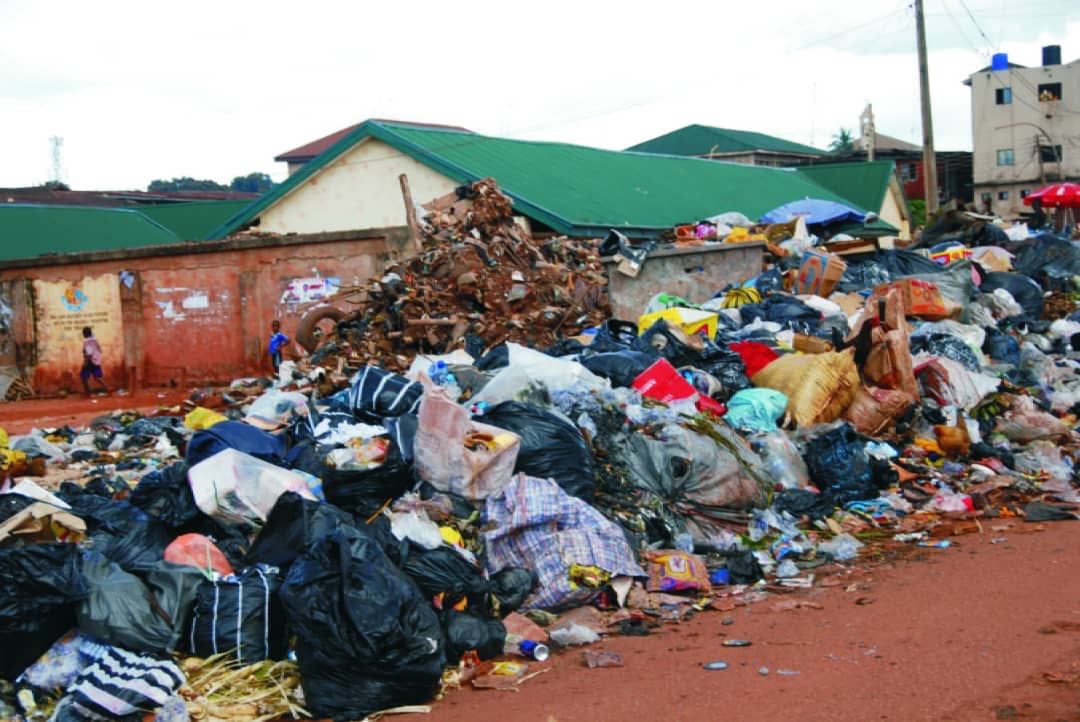
Owerri, the capital city of Imo state, South East Nigeria, faces a challenge. It stinks. Everywhere you turn, you meet with one refuse dump or the other. There is so much refuse dumped indiscriminately and nobody gets punished for that. Effective waste management forms a critical aspect of environmental transformation of any urban centre. In many cases, environmentalists, policy and decision makers constantly grapple with innovative ways to solve this conundrum even as population increases and industrialization thrives. Owerri was once labelled the cleanest capital in the South east of Nigeria under the administration of Governor Ikjedi Ohakim with his Clean and Green policy. This city is known for its booming hospitality and leisure industry with hundreds of hotels, petrol stations, and industrial parks. The effluents and wastes from these establishments have posed a difficulty for the waste handlers to effectively handle both domestic and industrial waste in both solid, liquid and gaseous forms, and put it to good use through recycling as is obtainable in more developed climes. From the urban centre of Owerri Municipal to adjoining communities that make up the metropolis such as Egbu, Nekede/FUTO axis, Mbieri, Nkworji, to Avu and Obinze, refuse dumps litter the roads including the inner streets to the extent that it has become a culture to dump domestic wastes on the road without a care for appropriate waste disposal.
Imolites have lamented that there were many other refuse dumps in Owerri, the state capital, adding that the pockets of refuse heaps had developed into huge dumps MCC/Uratta Road, World Bank Road, Ekeonunwa Market and Aba Road, lead the pack.
Not just refuse; even corpses are abandoned on Douglas road – Elizabeth, Shop owner
Elizabeth Agiaye, a business woman around Douglas Market says people can no longer bear the stench. She describes as unbearable the condition of the area from Ama-JK to Ekeonuwa market down to Douglas by Mbaise Road and Edede Street. She also disclosed that corpses of mentally deranged persons and destitutes with several kinds of diseases who hang around the roadside are often left unevacuated taking the hazard to peak levels. She said; “I have my shop just close to St Paul’s Catholic Church, the refuse dump is just facing us, we eat with it, attend to customers with it, inhale the stench every time and from opening of the shops in the morning till we close in the evening.” She says further; “It is bad enough that we have to face the refuse in itself, how about corpses? Just last week, a mad man died and his corpse remained at the spot he died for four days before the Owerri Municipal Council sanitary officers came to evacuate it. We had to wear face masks. Some shops had to lock up on the third day. It was that bad. If the government can do something to solve this refuse dump along this Douglas which is a very busy area in terms of human and vehicular traffic. On Saturdays you can’t pass here. The refuse will occupy one full lane. This is lawlessness, ‘healthlessness’ and a disaster already happening to us all,” she concluded.
My bus has been swept away due to blocked drainages – David, Imo Shuttle bus driver
For David Okezuo, a commercial bus driver, the Imo State Environmental Transformation Commission (ENTRACO) task force needs to clamp down on roadside sellers who dump the remains of their sales and goods in the open drainage thereby blocking the passageway. For him, making them pay heavy fines will serve as a deterrent. “Recently in September, my vehicle was almost swept away by the flood at Wetheral Road by MCC Junction because of flood concentration at that particular spot. The drainages around there were all filled up and blocked as a result of Banana sellers and other food sellers at that point. They do that every single day so the gutter becomes blocked.” “I had to abandon my vehicle overnight. I hardly slept that night for fear of losing my bus. So these people need to be sanctioned by ENTRACO because the refuse thing is too much, you find out that even the collection points that ISWAMA provided they destroyed it. It doesn’t last at all. They just prefer to dump their wastes inside the open drain and they are content with the smell. Owerri has become a mess really,” he concluded.
Environment impact
Perhaps the greatest effect of this alarming refuse situation in Owerri is on the environment and flooding. Every year, many residents are displaced due to flooding as a result of blocked sewage channels and underground tunnels that link waterways of the city. Houses as a result have been washed away by gullies. The impact in Owerri and environs has been devastating. In line to minimize loss of life and property during flood events, the National Emergency Management Agency, Owerri Operations in July, 2024 held an awareness campaign in Owerri with the theme “Waste Management and Flood Disaster Mitigation and Response Program.” The Owerri Head of operations NEMA, Mr Igwe Nnamdi harped on the importance of public education and awareness on flood risks taking proactive measures to protect themselves and neighbourhood. He emphasized that effective flood management requires a multifaceted approach which include strategic urban planning, sustainable drainage systems, flood resistant infrastructure, and early warning systems, among others. All of which according to him will not be possible without a hands-on approach to effective waste disposal, According to Mr Igwe,”improper disposal and inefficient recycling practices have led to overflowing landfills, polluted oceans and compromised ecosystems. The consequences are dire: from endangering wildlife to contaminating water sources, the effects of irresponsible waste management are far reaching and long lasting. However, we are providing solutions. By embracing sustainable practices such as recycling and reducing single use plastic, we can significantly alleviate the burden on our environment. Educating our communities on the importance of waste reduction and proper disposal is crucial. When each individual commits to responsible waste management, we collectively create a cleaner and healthier environment for future generations”.
Health Implications
Dr Andrew Ezimefula, a Director at the Imo state Ministry of Health warned of an inevitable epidemic if this situation continues unchecked. He added there is a latent period where toxins and microbes grow in the human body and familiarize with its host before it manifests its symptoms and begins to spread. He said “the presence of refuse dumps in and around us is a bad case. There is a popular saying that ‘Dirt doesn’t kill the African man,’ but this assertion couldn’t be more wrong because you may live with a disease-causing organism for years without knowing it because it will take some time to acclimatise itself inside your body as the host in order to fully manifest itself.” We have to be very careful in the way we manage our wastes both as individuals and as a society.” Dr Ezimefula added that in the public health facilities based in Owerri such as Imo specialist Hospital Umuguma and the Federal University Teaching Hospital (FUTH) Owerri, patients are coming with cases that show poor hygiene conditions and infections due to ingestion and inhalation of toxins and skin reaction such as Respiratory problems, cancer, diarrhoea, neurological damage etc. “The cases we are receiving at FUTH Owerri and Umuguma Specialist hospital are quite scary,” he informed. “You see Bronchitis, Asthma, Lung cancer, even cardiovascular diseases and am not even talking of the usual cholera and diarrhoea. We just scaled through a minor epidemic in November. Proper waste disposal facilities with incinerating capacities need to be fixed in Owerri.” Dr Andrew advised.
The Imo State Waste Management Agency (ISWAMA)
Prior to the establishment of the agency, collection of wastes was a private affair where individuals utilize the gap to set up a money spinning business as waste collectors in homes, streets and even in communities. Non-patronizers resort to illegal dump sites, sewage tunnels and even the open roads to dump their wastes. Established under the Imo State Waste Management Agency Law, 2020, the Imo State Waste Management Agency (ISWAMA) had the sole responsibility of making Imo State clean while making useful resources out of waste. Under the supervision of the State Ministry of Environment, ISWAMA embarked on the collection of wastes at designated points across the municipality of Owerri at various times of the day while acting as a revenue collection agency. But investigations by this reporter revealed that even with the organised structure of the waste collection agency, environmental sanitation became worse. In the popular Ekeukwu market along Douglas road for instance mountainous refuse is dumped on the road side that it totally covers one part of the dual carriage way, making it difficult for road users to have unhindered access with gridlocks to go with it.
In an interview, the erstwhile Chairman of the Imo State Waste Management Agency, Mr Peter Ezeobi, while responding to these complaints and accusations of corruption said efforts were on to evacuate all the refuse heaps on roads in the state. Ezeobi stated, “We have cleared the refuse dumps on the Douglas Road, MCC/Uratta Road and Aba Road. He added; “We knew why they had stayed before the recent evacuation. The state government has provided all the logistics for the evacuation. Within the shortest time, they will all be cleared,” he said. Continuing, he added that any of its officers found wanting should be reported for immediate investigation and prosecution but despite his strong assurances and despite no extorting officer of ISWAMA was penalised.
Government Interventions
The government of Imo state also set up a committee to look at the location of the various Hostels and Eateries in the State capital and ascertain whether they are located and built on the appropriate places, and that any one not sited at the right place according to the Owerri Master Plan will not only be sealed-up but the owners of such Hostels, Eateries and Event Centres will be held accountable, arrested and prosecuted according to ENTRACO Law No. 3. Also, to signal the end of the reign of ISWAMA, the Imo State Government and a German firm called Eastern Waste Management Company Limited recently signed a Memorandum of Understanding to achieve a clean, hygienic and environmentally friendly State via proper waste gathering and recycling.
Governor Uzodimma explained that the state House of Assembly passed the Private Public Partnership (PPP), Law No 11 in 2018, “to enable government partners with private establishments to optimise values and utilisation of opportunities for the people.” He emphasised that funding and the cost of keeping the environment clean in relation to lean resources of the State have made it necessary that the government partners with companies and agencies in critical areas to achieve results.
Imo state continues to battle with indiscriminate refuse disposal despite the interventions from the Imo state government. It remains to be seen if these interventions by the state government will yield the desired result but these solutions need to be manifested for the sake of the health of its residents (which has directly impacted their productivity), and the stability of the environment (including the flora and fauna). The health of Owerri’s environment is the wealth of its inhabitants.