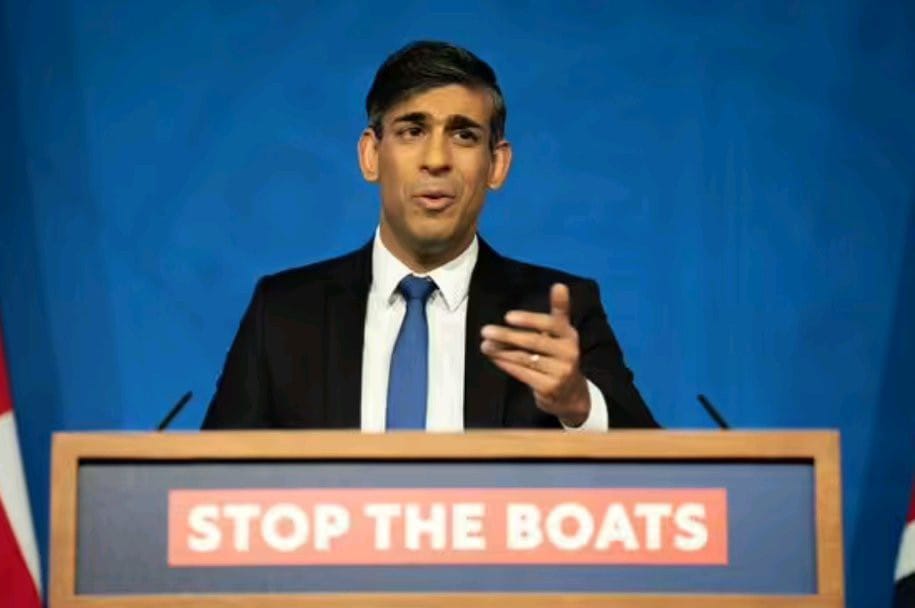
Action has indeed matched words, as the UK deported its first migrant to Rwanda, marking a notable shift in the country’s approach to handling illegal immigration.
EKWEANAEDO ONLINE gathered that the action, carried out under Prime Minister Rishi Sunak’s directive, has sparked both support and criticism, raising questions about the ethics and effectiveness of such measures.
The deportation, according to reports, involved relocating an unnamed African migrant to Kigali, Rwanda’s capital. The individual had exhausted all legal options to stay in the UK and accepted the relocation to Rwanda, highlighting the complexities of asylum policies and the challenges faced by migrants seeking safety.
Supporters of the deportation view it as a success in the UK government’s efforts to address illegal immigration. However, critics question the motives and implications of the move, pointing out its timing close to upcoming local elections. This timing has fueled speculation about potential political motivations and concerns over prioritizing optics over true humanitarian care.
The voluntary aspect of the deportation brings up critical ethical issues. Although the individual may have agreed to the relocation, the circumstances surrounding the decision are not entirely clear.
Additionally, the provision of taxpayer-funded financial support for resettlement complicates the situation, raising questions about government spending on deportation initiatives compared to support for asylum seekers in the UK.
Government officials have praised the deportation as a successful “proof of concept” and a possible model for future removals under new legislation. This proposed legislation seeks to streamline deportation processes and expand the list of countries deemed “safe third countries,” a plan that has faced strong opposition from human rights advocates and opposition parties.
Critics, including former Conservative Home Office ministers and Labour’s Yvette Cooper, have criticized the deportation as an expensive, pre-election maneuver. They express concerns about transparency, accountability, and the potential erosion of migrants’ rights. Cooper emphasizes the worry that taxpayers are funding a politically driven initiative, highlighting broader concerns about the government’s priorities and fiscal management.
According to information available to the EKWEANAEDO ONLINE, the controversy around the UK’s deportation to Rwanda reveals the broader challenges of immigration policies and national identity. Advocates call for stronger measures to curb illegal immigration and protect national security, while opponents caution against the erosion of humanitarian principles and the demonization of vulnerable groups.
Furthermore, the deportation to Rwanda highlights the complexities of international cooperation on migration issues. While the UK government views its partnership with Rwanda as progress, critics warn about outsourcing asylum obligations and the risk of human rights violations in third countries.
As discussions continue, it is important to consider the values and principles guiding the UK’s approach to immigration and asylum. Balancing border control and national sovereignty concerns with the need to uphold human rights, dignity, and compassion for those seeking refuge is crucial.
The UK’s first deportation to Rwanda serves as a point of reflection on immigration policy, political accountability, and the moral responsibilities of states in a globalized world. Whether seen as a milestone or a controversy, it highlights the profound moral and political dilemmas in managing migration in the modern era.
Recall that the UK Government, had earlier (in April) deliberated on a bill known as the Rishi Sunak’s Rwanda Bill, which seeks to send some asylum seekers to Africa.