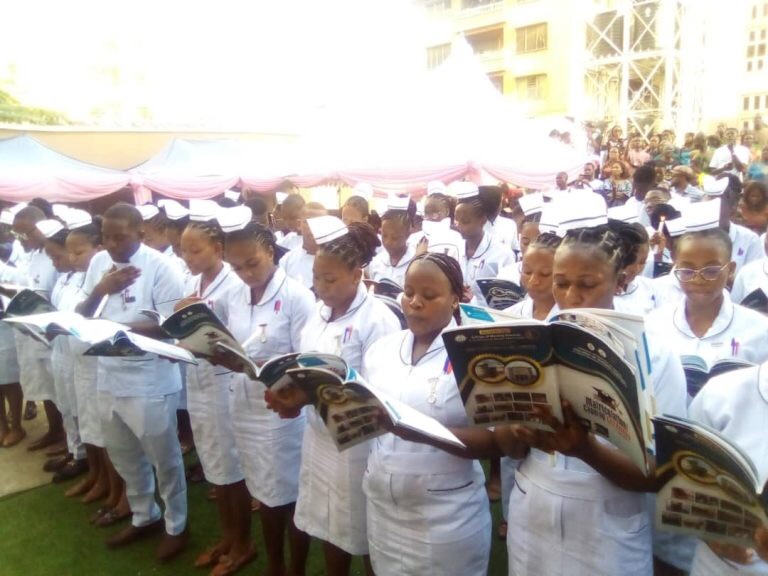
President of the National Association of Nigeria Nurses and Midwives (NANNM), Comrade Haruna Mamman has revealed that no fewer than 15,495 nurses have left Nigeria for foreign practice as of February, 2025 due to poor welfare and working conditions.
Mamman who made the revelation at the end of the National Executive Council (NEC) of NANNM on Thursday in Abuja, raised concerns that the situation was becoming alarming as it could pose a big manpower threat to timely and quality health care delivery services in Nigeria.
According to him, the failure of the Nigerian government to Gazette the Scheme of Service for health workers approved in 2016, about nine years ago, was a major reason for the migration, as government has continued to display lackadaisical attitude towards the welfare and conditions of service of nurses’ and midwives’ working in the country.
He said: “Another challenge is the issue of industrial court judgment that has not been implemented, as well as the request for the
decentralisation of internship opportunities for those who have graduated from the nursing schools, and are seeking opportunity for internship.”
While regretting that the issues have lingered for too long a time, Mamman noted that though nurses were not expected to participate in an industrial action given its harsh effect on seamless health service delivery, wisdom and diplomacy were being applied by the nurses to address the issues.
National Secretary of the Association, Dr. Thomas Shettima, warned against the growing proliferation of nursing schools across the country, insisting that such actions, or increasing of the production of nurses and other health personnel is not the solution to the “japa” challenge being experienced in the health sector, but will rather breeding official quacks.
“By the time you have produced those that you cannot employ, and they have already acquired the knowledge, and are unable to go outside, they remain in the society. And if they are in the society, and are jobless, they have the knowledge and are approached for any treatment for their services, they will definitely go and render those services. And in rendering the services, some could go outside their ways, because they must survive.
“Therefore, if we want to curtail the “japa” syndrome, we must first ask ourselves, why are people going outside the country? If we get the answer, then we will be able to address it.
“Simply, people are moving outside Nigeria, in fact, all professionals are moving outside Nigeria, particularly the nurses, because the welfare, their condition of service and welfare is not good enough.
“For instance, there are some allowances of nurses and midwives that have not been reviewed for over 30 years now. And any call to review that is met with resistance. For a more durable solution, the government need to sit with the relevant authorities, particularly in the case of the nurses and midwives, to discuss the way forward.
“Opening 1,000 schools of nursing in every state will never be a solution to ‘japa’. People will still be going to look for a better condition of service. But if we improve our own here, and then train qualified persons to handle our health care, I want to believe it’s the solution to ‘japa’ syndrome.”
Comrade Umar Suleiman Bako, Kogi State NANNM Chairman lamented the prolonged delay in the implementation of the approve Scheme of Service for the nurses that was approved in 2016.
Suleiman challenged the Association to work closely with the Nursing and Midwifery Council of Nigeria (NMCN) to step up and strengthen their monitoring system to ensure quality and standards were maintained across all institutions of nursing and midwifery in the country.
“This was one of the push factors for nurses and midwives who are apparently fed up with the poor renumeration, and are seeking better opportunities abroad. It’s important to note that it’s the nurses among other health care workers in this country that their scheme of service has not yet been gazetted.
“In Kogi state, the challenge has affected the renumeration and career development of nurses who are serving in the different three employment stages, notably, primary, secondary, and tertiary. They are paid differently because there’s no approved payment scheme.”